Hope Rasa | Department of Journalism | Western Washington University | JOUR 480: Senior Seminar | Dr. Sheila Webb | June 2, 2026


Discussion and Conclusion
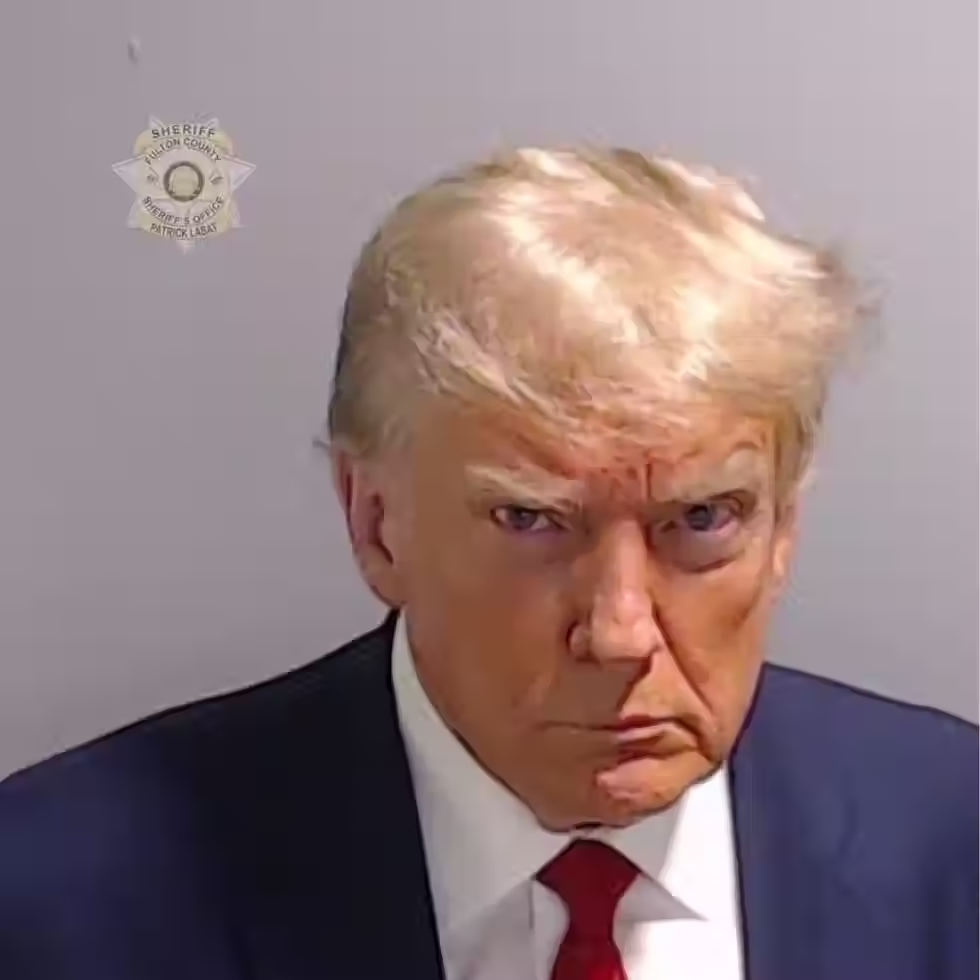
What just happened?
Now what?
The data from Trump’s voter approval polls tell a story; he’s hemorrhaging support from voters. Especially, but not exclusively, Democrats. Trump’s voter approval ratings are sinking in unison with the Iran war. With the midterms drawing closer each day, Trump’s falling voter approval ratings are becoming increasingly important. They could very well be dark clouds ahead for Trump and his party. News coverage of Trump’s falling approval ratings are as important as the ratings themselves, serving as records of this shift in voter opinion and possibly serving to amplify discontent with the president.
As the war’s economic consequences grow harder to ignore, Trump’s voter approval ratings continue to decline in response. Between this, and the fact that some polls include questions about the Iran war and/or economy, journalists have every reason to highlight those two factors as the driving force behind Trump’s sinking approval. News coverage doesn’t hesitate to point out that his numbers are sinking either, frequently using decidedly negative language like “weak,” and “low,” to describe Trump’s voter approval. Lastly, news coverage usually calls attention to the fact that Democrats generally approve of Trump less than Republicans, and they’re losing what approval they do have much faster.
However, something not often included in the news coverage that I analyzed was any mention of the Epstein Files. Not a single one of the articles that I coded for my project mentioned the Epstein Files. Now, most polls fail to include a question about the Epstein Files as they do questions about the economy, Iran war, and other key issues. However, it seems obvious that recent revelations surrounding the Epstein Files may contribute, at least a little, to Trump’s tanking approval ratings. I don’t believe it would constitute editorializing if a journalist dared to mention the Epstein Files as a potential factor in Trump’s current voter approval ratings. Admittedly, the mystifying lack of attention toward the Epstein Files seems to be a widespread issue in American society. While the news coverage that I analyzed for this project aren’t the sole or primary perpetrators of this ‘Epstein amnesia,’ they do contribute to it.
Entman (1993) can help to explain why the news coverage I analyzed for my project leaves the Epstein Files out of the picture. According to Entman, communicators (in this case, journalists) can make unconscious or conscious judgements about framing guided by schema that uphold their belief systems (p. 52). I believe that the journalists responsible for the news coverage I analyzed made unconscious judgments to omit the Epstein Files from their articles. The absence of certain key words, like “Epstein Files,” can manifest frames in the text (Entman, 1993). By neglecting to bring up the Epstein Files even once, news coverage of Trump’s falling approval rates framed the files as being complete non-factors.
Considering news coverage often makes no bones about the fact that Democrats and Republicans differ substantially in their approval of the president, it’s important to remember that Democrats and Republicans also consume the news differently. According to a study by McCaffrey et al. (2019), Republicans tend to trust news ethics and honesty less than Democrats. McCaffrey et al. also found that Republicans consume less traditional forms of news media. My project observes partisanship layered on partisanship; I found that news coverage often frames Trump’s approval as a partisan matter, but news coverage in and of itself is a partisan matter.
News coverage of Trump’s voter approval ratings may have the power to influence those ratings in the future. News framing does in fact have the power to affect public approval of a president. In their study, Shah et al. (2002) found that the surprisingly high voter approval ratings that former president Bill Clinton received during his public sex scandal were a complex response to a number of factors. One of these factors, Shah et al. found, was the framing of news coverage of the economy at the time. It’s entirely possible that news framing of Trump’s falling voter approval ratings may, in combination with a number of other factors, affect those ratings even more.
Consequences for Trump? Who Knows.
It’s important not to overemphasize the potential effects of news framing of Trump’s falling voter approval ratings. Trump has remained an unrelenting presence in U.S. politics despite plenty of unfavorable news coverage for over a decade now. I’m not attempting to argue that this coverage of Trump’s falling voter approval ratings – as negative as it may be – will serve as the final nail in the coffin. However, in combination with factors such as rising gas prices, inflation and much more, news framing of Trump’s falling voter approval ratings may have consequences for the president and Republicans as a whole.
What those “consequences” may be remains abstract. Perhaps there will be a blue wave come midterms, although Republican gerrymandering efforts are making that increasingly unlikely. It’s also possible, though not likely, that lower voter approval ratings for Trump may embolden Republican members of Congress to act against him. It’s important to note that the further Trump’s approval falls, and the less likely Republicans are to win seats in Congress this November, the less power the president will have to interfere with the 2028 presidential election. There are many possibilities as to what the consequences of Trump’s increasingly dismal voter approval ratings could mean for him and his party down the road. It’s also entirely possible that there will be virtually no consequences at all. Plenty of Trump’s other scandals, broken promises and blunders have waltzed right through the news cycle with little to no consequences for Trump or the Republican party.
In the event that Trump’s falling voter approval ratings – and news framing of those ratings – do end up affecting him in some way, examining past presidents can help create an idea of what those effects could be.
For instance, former president George W. Bush experienced incredibly low voter approval ratings thanks to his handling of the Iraq war and the economy. Bush had an average voter approval rating of 90% in September 2001, in the wake of the Sept. 11 terrorist attacks (Gallup, n.d.). Bush’s initiation of the Iraq war, his handling of said war, and his response to the Great Recession combined to tank his voter approval ratings. By October 2008 – the month Bush signed the Emergency Economic Stabilization Act into law – his average voter approval rating dropped to 25%. By that point, Bush’s ratings had been on the decline for a while. In 2006, the middle of Bush’s second term (where Trump is right now), he started the year with an average approval of 42% and finished the year at 38%.
There are clear parallels between Bush and Trump’s presidencies: unpopular wars in the middle east, lackluster responses to economic strife, to name a few. Since Trump’s second term is passing many of the same landmarks as Bush’s, it’s not unreasonable to predict that he may arrive at a similar destination. This could mean a blue wave, less Congressional support, and a Democrat successor– all things that happened during Bush as the result of voters’ dissatisfaction with him and Republicans as a whole.
Sarah Longwell coined the term “Bush line,” to describe her theory that once a president's voter approval ratings dip below 32%, as Bush’s did during his second term, there’s no coming back (Lynch, 2025, para. 11). Longwell is a former Republican, a writer and a political consultant who focuses her efforts on fighting Trump’s control of the Republican party. The “Bush line” theory argues that once Bush’s approval fell below 32% and anchored there, it weakened the Republican party and paved the way for Democrat Barack Obama to win the next two elections. If the “Bush line” theory proves true in Trump’s case, it may spell a weakened Republican party and a host of opportunities for Democrats to regain power.
Future research into this topic could compare the impact of reporting on Trump’s approval ratings with the impact of reporting on multiple previous presidents’ approval ratings. During this project, I touch briefly on the impact of reporting on Clinton’s approval ratings during his sex scandal. I also examine how Bush failed to recover from his low approval ratings once they had passed a certain point. However, I feel there was a missed opportunity to compare how news coverage of sinking approval ratings have affected past presidents, not just the factors behind the ratings. I believe this topic would be especially interesting to revisit once Trump’s presidency has concluded, and his approval ratings are no longer changing by the day.
One limitation of my work is the constantly evolving flow of information involved with my topic. As I worked on this project, new polls came out and more articles were published about Trump’s falling approval ratings. I attempted to chase after more recent coverage as it came out in order to create a project that was as up-to-date and impactful as possible.
Another limitation of my work is the number of articles that I coded, which was 13. Coding at least a few more may have helped me to discover new trends or details that weren’t apparent in the other articles I examined.
Finally, I consider the timeframe of my project to be both a limitation and an opportunity for future research. I analyzed news coverage from April-May, 2026. It would be interesting to code a larger number of articles, including ones from the very beginning of Trump’s second term up until the present. Doing that may reveal changing trends in terms of how news coverage has framed Trump’s approval ratings as they’ve gotten progressively worse since 2024.